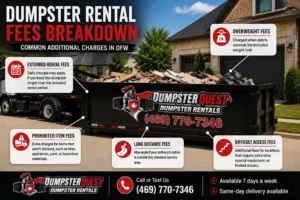
You only pay a dumpster permit fee when the container sits on public property, such as a street, sidewalk, alley, or shared right-of-way. The city charges the fee, not the rental company, and it is not included in the rental price. A dumpster on a private driveway or lot avoids the fee in most Dallas-Fort Worth cities. When a permit is needed, the cost, how it’s calculated, and the approval time all depend on your city.
Key Takeaways
- Each city charges its own permit fee, not the rental company, and the fee is separate from the rental price.
- You only pay a fee for placement on public property: streets, sidewalks, alleys, or shared right-of-way.
- Keeping the dumpster on a private driveway or lot avoids the fee in most DFW cities.
- Cities charge flat fees, duration-based fees, or both, and may add renewal fees.
- Matching the permit length to the full rental period avoids renewal fees and fines.
Who Pays the Dumpster Permit Fee: You or the Rental Company?
In most cases, the renter or property owner pays the permit fee, because they are the one placing the container on public property. The city issues the permit and collects the fee directly. Some rental companies apply on the customer’s behalf and pass the cost along, so ask whether the fee is included before you book.
The permit fee is always separate from the rental cost. Rental pricing covers the container, delivery, the rental period, and included weight, as explained in our dumpster rental pricing guide.
How Can You Avoid a Dumpster Permit Fee Entirely?
You can usually avoid the fee by keeping the dumpster on private property, such as your driveway or a private lot. Most DFW cities don’t charge a permit fee for private placement, so there is no application and no approval wait.
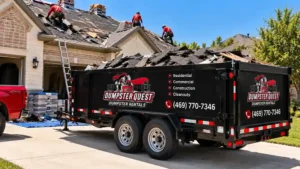
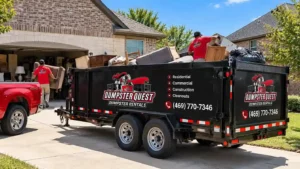
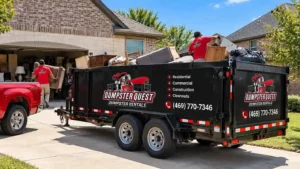
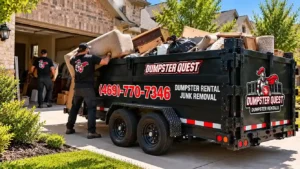
Dumpster Quest DFW uses a 20-yard dump trailer on rubber tires instead of a steel roll-off. The rubber tires are designed to roll onto concrete and asphalt without the scraping risk of heavy steel containers, which makes driveway placement practical for most homes. See our driveway-safe dumpster rentals for details. If you’re moving and want help with driveway placement, HOA rules, and space, read our driveway permit and placement guide for moving.
How Do DFW Cities Calculate Dumpster Permit Fees?
There is no single DFW rate. Each city sets its own fee structure. Most cities use one of these approaches, or combine them:
- Flat application fee: a one-time charge to review and approve the permit.
- Duration-based fee: a charge tied to the number of days the dumpster occupies public space.
- Renewal or extension fee: an added charge if the dumpster stays longer than the original permit allows.
Many cities also require safety measures such as traffic cones, reflective markings, or barrier signs on public property, which can add to your setup. Your city’s public works or engineering department can confirm the current fee for your address.
How Do Placement Options Compare on Cost?
| Factor | Private Driveway or Lot | Public Street, Sidewalk, or Alley |
| City permit fee | Typically none | Set by each city |
| Possible added costs | None from the city | Renewal fees, safety markings |
| Approval wait | None | Often several days |
| Risk of a fine | None from the city | Yes, if placed without a permit |
| Best for | Most homes with driveway access | Lots with no private space |
What Is the Difference Between a Short-Term and Long-Term Dumpster Permit?
A short-term permit covers a few days. A long-term permit covers a longer rental period. Short-term permits cost less upfront, but renewals add up if the project runs over. Long-term permits usually cost less overall for multi-week renovations or estate cleanout dumpster rentals.
How Does Rental Length Affect Your Permit Cost?
Your permit should cover every day the dumpster sits on public property, so rental length and permit length need to match. Dumpster Quest DFW rentals come in 2-day, 4-day, and 7-day packages, with extra days at $20 per day. If you extend the rental, check whether your street permit needs a paid extension too.
Base both on your full project timeline, not your most hopeful estimate. A permit that runs out before pickup can bring a renewal fee or a fine.
Do Dumpster Permit Fees Change From City to City in DFW?
Yes. Permit fees, approval times, and placement limits differ across DFW, so what you paid in Frisco won’t tell you the cost in McKinney, Plano, or Allen.
At the state level, the Texas Commission on Environmental Quality (TCEQ) regulates solid waste disposal. In cities such as Allen, Frisco, McKinney, Plano, and Richardson, waste disposal runs through the North Texas Municipal Water District (NTMWD) regional system. Neither agency issues street-placement permits or charges placement fees. Those come from each city. For a city-by-city overview, see our dumpster rental permits guide.
What Mistakes Make Dumpster Permits Cost More?
The three mistakes that raise permit costs are:
- Buying a permit that’s too short. If the project runs over, you pay a renewal fee on top of the original permit.
- Skipping the permit for street placement. This can lead to a fine or a forced move in the middle of the project.
- Applying on delivery day. Approval can take several days, and waiting can use up paid rental days.
Your city’s official website is the final word on fees. For example, the City of McKinney’s official website lists local permitting departments and contacts. Dumpster Quest DFW reviews where the dumpster will go with every customer before booking.
What Do Typical Permit Cost Scenarios Look Like?
These two typical situations show how planning affects what you pay:
- Fee avoided: A homeowner planning street placement learns that a permit fee applies. They move the rubber-tired trailer onto the driveway instead and pay no city fee.
- Renewal avoided: On a tight lot with no private space, an owner expects a three-week renovation. They buy a permit for the full rental period instead of a short-term permit, so they don’t pay a renewal fee partway through.
In both cases, the owner made the permit decision before delivery day.
How Do You Budget for a Dumpster Permit Fee?
Follow these four steps:
- Decide where the dumpster will go. Private property usually means no fee.
- If you need the street, contact your city for the current fee structure and approval time.
- Match the permit length to the full rental period, including any extra days.
- Add the permit to your project budget next to the rental cost, and apply several days early.
Where Does Dumpster Quest DFW Deliver?
Dumpster Quest DFW serves McKinney, Frisco, Allen, Plano, Prosper, Celina, Lewisville, Carrollton, Wylie, and the rest of our Collin County and North DFW service area. To check placement and permit needs for your address, call 469-770-7346 or send us your project details.
Frequently Asked Questions
1. Is the permit fee included in the dumpster rental price?
No. The city charges the permit fee separately from the rental. Some rental companies apply for the permit and pass the cost along, so ask before booking.
2. How much does a dumpster permit cost in DFW?
There’s no single regional rate. Each city sets its own fee. Some charge a flat application fee, and others charge by the number of days the dumpster takes up public space. Your local city office can confirm the current fee for your address.
3. What happens if you put a dumpster on the street without a permit?
The city may issue a fine or require you to move the dumpster. Moving it partway through a project can also cost you rental days and labor.
4. What is the difference between a short-term and a long-term dumpster permit?
A short-term permit covers a few days at a lower upfront cost. A long-term permit covers a longer rental period and usually costs less overall for multi-week projects. Choose the one that covers your full rental window.
5. How far in advance should I apply for a dumpster permit?
Apply several days before delivery. Approval times vary by city and are often not same-day.
6. Who pays for the dumpster permit: the renter or the rental company?
Usually the renter or property owner pays, because they are the one placing the container on public property. Some rental companies apply on the customer’s behalf and pass the fee along.